
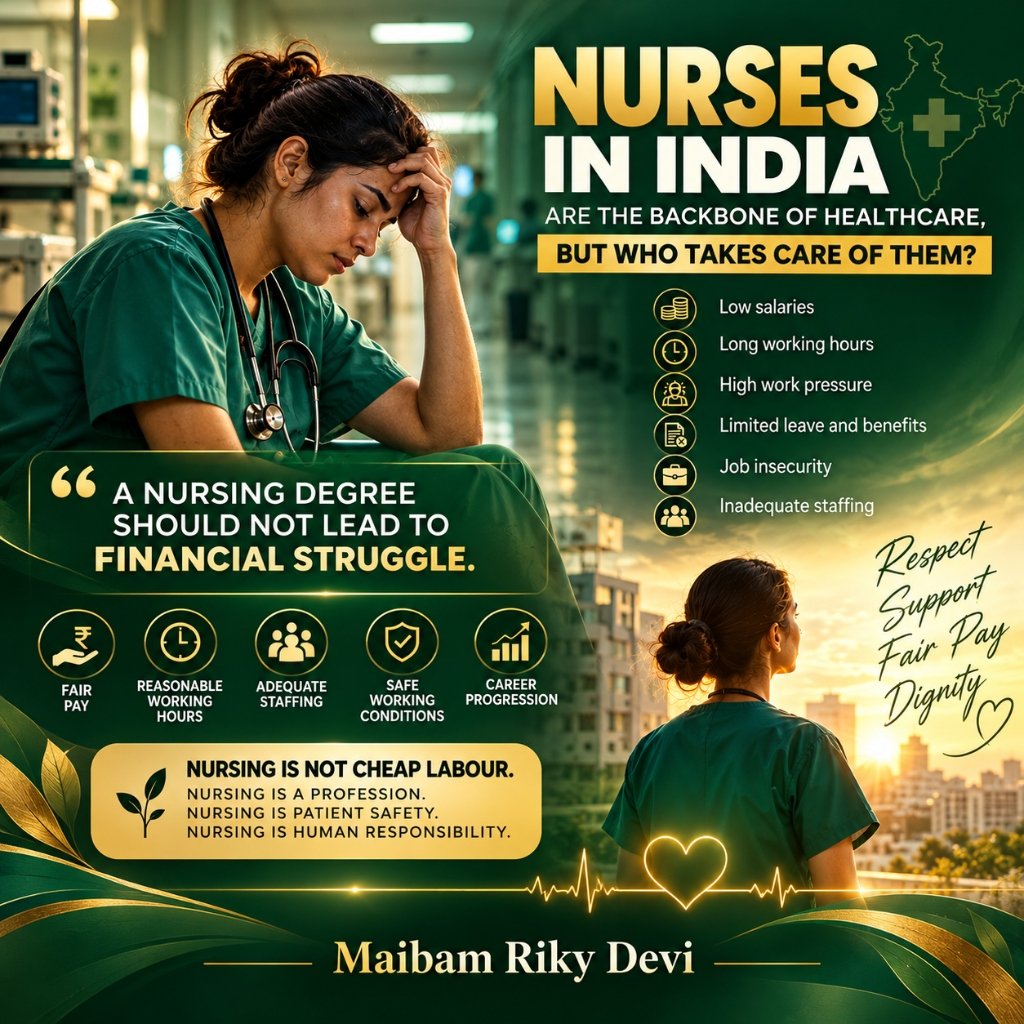
Nurses are among the most essential professionals in any healthcare system. They are present when patients enter a hospital, when families are frightened, when emergencies occur, during long nights in intensive care units, and throughout the recovery process.
Across India, nursing is a profession that demands education, clinical competence, emotional strength, physical endurance and enormous responsibility. But for many nurses—particularly in parts of the private healthcare sector—the reality of employment can include relatively low pay, long working hours, heavy patient loads, limited rest, insecure contracts and inconsistent employment benefits.
This does not mean that every private hospital treats nurses poorly. There are many hospitals that provide competitive salaries, professional development, insurance, provident fund, accommodation and better working environments.
The problem is the lack of consistency and the significant gap between the value of nursing work and the conditions experienced by some nurses.
The evidence deserves a serious conversation.
A nurse is not simply an employee performing routine hospital tasks.
Nursing requires professional education, registration, clinical judgment, medication administration, patient monitoring, emergency response, infection-control practices, documentation, communication with doctors and families, and the ability to respond to rapidly changing patient conditions.
The World Health Organization (WHO) describes nurses as the largest occupational group in healthcare and an indispensable part of efforts to achieve universal health coverage. Its State of the World's Nursing 2025 report emphasizes the importance of investing in nursing education, employment, leadership and working conditions.
When nursing professionals are overworked or inadequately supported, the issue is not merely an employee-welfare issue—it directly translates into a healthcare-quality and patient-safety issue.
India does not have one uniform private-hospital employment model.
A nurse working in a large corporate hospital in Mumbai, Delhi, Bengaluru or Hyderabad may have a very different experience from a nurse working in a small private hospital, nursing home or clinic in a smaller city or rural area.
Salary, staffing, working hours, benefits and career progression can vary significantly depending on:
- Hospital size & bed capacity
- Geographic location
- Qualification & registration standard
- Nursing specialization
- Experience & seniority
- Patient load
- Employer structure (Trust, Corporate, Proprietor)
- Type of contract (Permanent vs Contractual)
- Availability of skilled nurses
- State-level labour regulations
Therefore, it would be inaccurate to say that all private hospitals exploit nurses. But it would be equally inaccurate to ignore the documented evidence showing serious problems in parts of the sector.
One of the most important formal studies on this subject is the 2022 World Health Organization Country Office for India study on employment and working conditions of nurses in selected private hospitals in Delhi.
The study interviewed 31 nurses and key informants and examined recruitment, remuneration, workload, nurse-patient ratios, workplace facilities, benefits, occupational safety, harassment, grievance mechanisms and regulation. It was explicitly an exploratory study of selected private hospitals in Delhi—not a national survey of every private hospital in India.
These are not simply social-media complaints. They have been documented in a formal empirical inquiry published by WHO India.
One of the most sensitive issues in nursing is compensation.
The WHO India study found substantial variation in private-hospital salaries in the Delhi sample. It reported salaries ranging from below ₹15,000 for freshers to around ₹45,000 even for nurses with more than 10 years of experience in the settings studied. It also documented cases where arbitrary deductions were made for issues such as reporting late or ward equipment loss.
The study further found sharp divides between corporate and non-corporate hospitals. Some corporate hospitals offered starting salaries around ₹20,000, while respondents from non-corporate hospitals reported starting salaries ranging approximately from ₹11,000 to ₹18,000, with one respondent describing an offer of ₹9,000 as a fresher.
Claims that nurses in India receive salaries as low as ₹3,000–₹4,000 have appeared in public discussions.
For example, during a 2017 parliamentary discussion concerning nurses in private hospitals, an MP stated that some private nurses were reportedly receiving only ₹3,000–₹4,000, while arguing for implementation of higher pay recommendations. This was a reported parliamentary statement, not evidence that ₹3,000 was or is the typical national salary of nurses across India.
Historical research has also documented very low private-sector nursing pay in earlier periods. A working paper reviewing the sector noted that some private-hospital nurses in major cities received ₹3,000–₹7,000 in hand in the late 2000s and early 2010s.
The distinction matters: We should not use an isolated historical figure as today's national average. Instead, the evidence-backed reality is clear: India has a long-standing, documented problem of wide variation and inadequate compensation for some private-sector nurses, remaining a continuous subject of legal, regulatory and professional debate.
The issue of private nurses' pay has repeatedly reached India's constitutional courts.
Following litigation concerning the working conditions and pay of nurses in private hospitals and nursing homes, a Government of India Expert Committee recommended differentiated salary standards based on hospital bed strength:
- • >200 Beds: Private nurses should receive pay at par with State Government nurses.
- • >100 Beds: Salary difference should not exceed 10% below the State Government level.
- • 50–100 Beds: Salary difference should not exceed 25%.
- • <50 Beds (Mandatory Floor): Private nurses should not receive less than ₹20,000 per month even in small hospitals.
The Delhi High Court subsequently upheld the Delhi government's effort to implement the recommendations in the context before it. This history demonstrates that concerns about private nurses' pay have been serious enough to reach the Supreme Court, High Courts and national expert committees.
Salary is only one side of the problem. The other is time.
Nursing is a 24-hour profession. Hospitals cannot close at 5 p.m. Patients require continuous observation throughout the night. That makes shift management, adequate staffing and rest periods critical.
The WHO India study documented nurses working 8- to 12-hour shifts, with respondents reporting that obtaining adequate rest during shifts was difficult. Many reported staying beyond scheduled duty hours to complete documentation and handovers. In one account, a team leader spent an additional two to three hours completing paperwork after duty.
A hospital can have modern equipment, attractive buildings and marble reception lobbies. But without enough nurses, the quality of care deteriorates.
The Indian Nursing Council (INC) publishes clear staffing norms:
Yet the WHO India study documented instances in selected private hospitals where nurse-patient ratios were reported to stretch to 1:30, accompanied by non-clinical administrative burdens.
Staffing is fundamentally a patient-safety issue. When a nurse is responsible for thirty patients simultaneously, either time with patients, documentation, rest, communication, or safety must inevitably be compromised.
One of the most striking findings from the WHO India study concerns something surprisingly basic: Rest.
Some nurses reported having no designated opportunity or facility to sit during long shifts. The study documented reports of insufficient seating, inadequate rest rooms, and the difficulty of completing 8- to 12-hour shifts without meaningful rest breaks. Some nurses noted having to gulp their food in minutes and immediately rush back to the ward due to staff shortages.
While healthcare requires standing, the combination of long shifts, insufficient staffing, heavy patient loads, and no seating creates severe occupational-health risks.
Salary is not the complete package. True employment security encompasses: Provident Fund (PF), Employee State Insurance (ESI), medical coverage, gratuity, paid leave, maternity benefits, overtime pay, and night-shift allowances.
The WHO India study revealed deep structural divides: while larger corporate hospitals often provided PF, gratuity and healthcare benefits, other nurses received merely a consolidated wage without social security.
Furthermore, the study documented a troubling "Fresher Preference" in some institutions: replacing experienced nurses with junior graduates at lower salaries on fixed-term contracts. This creates an unviable cycle:
A professional healthcare system must instead enable:
The problem does not begin after graduation—it begins during nursing education.
Students invest four or more rigorous years in tuition, clinical postings, uniforms, books, and living expenses. After graduation, many expect that professional employment will provide financial dignity. Instead, some enter the workforce treated as perpetual 'trainees' with minimal stipends despite carrying full clinical duties.
This is not a historical issue.
In March 2026, private-hospital nurses in Kerala entered an active industrial dispute over pay and working conditions. Nurses affiliated with the United Nurses Association (UNA) formally demanded a ₹40,000 monthly basic salary, while the state government published revised minimum-wage frameworks.
This ongoing dispute illustrates that nursing compensation, nurse-bed ratios, and three-shift systems remain urgent, active policy priorities across India today.
Improving nursing employment must be treated as a strategic investment rather than an overhead expense:
The answer to "Who takes care of the caregivers?" cannot simply be: "The nurses will manage."
Healthcare systems must take care of them. Governments must regulate effectively. Hospitals must provide decent employment. Patients and families must respect their work. And society must recognize that nursing is not cheap labour—it is skilled healthcare, patient safety, and clinical responsibility.
Advocating for ethical standards, healthcare dignity, and evidence-based workplace equity.